.png?width=300&height=100&name=Copy%20of%20Rise%20Beyond%20Logo%2012.31.24%20(300%20x%20100%20px).png "Rise Beyond Fly Fishing Co. logo featuring a cowboy riding a large trout, holding a fishing rod in one hand and a camera in the other, with stylized text in a rugged, outdoor-themed font")
.png)
The Eagle is a winter workhorse when it is running clear. It is not flashy this time of year, but it is consistent if you fish the right water and keep your drifts short and clean. Think inside seams, softer buckets, and any walking-speed lane that lets trout feed without spending calories.
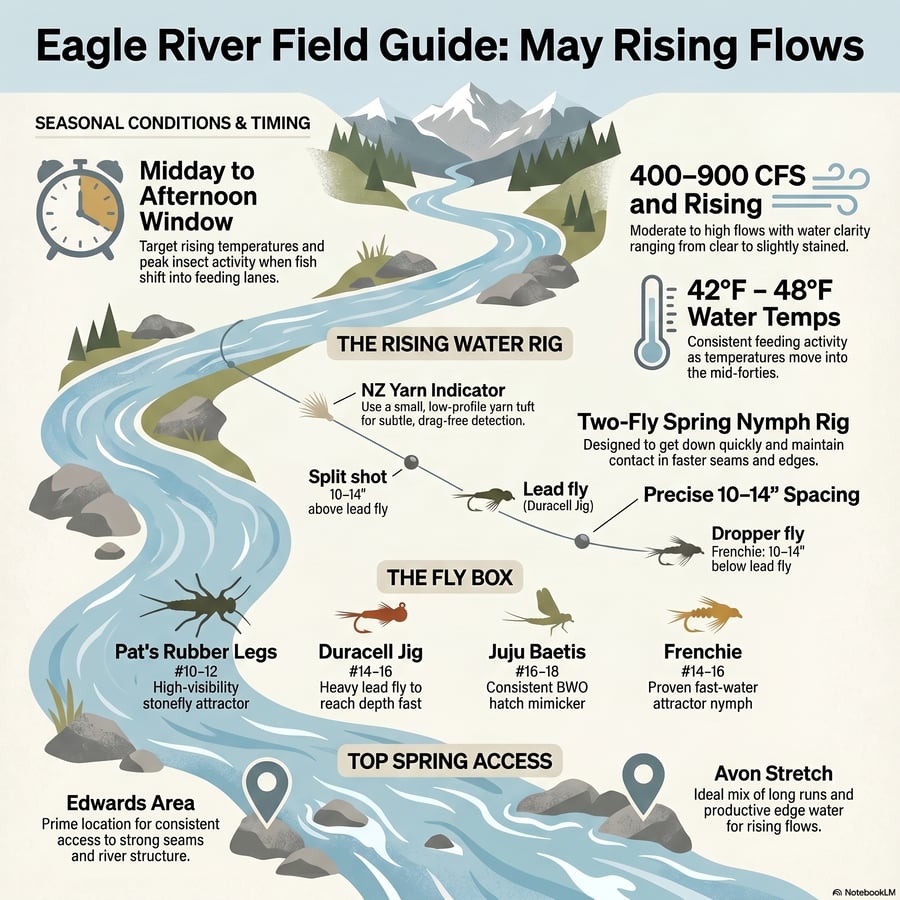
Updated: May 4th, 2026
The Eagle is in that classic early May window where it’s fishing well, but changing fast. Flows are rising, clarity is starting to shift, and fish are feeding more aggressively than they were even a week ago.
This is a short window before runoff really takes over. Fish are active, willing to move, and responding to both nymphs and streamers, but conditions can change quickly with heat and snowmelt. If you time it right and stay mobile, you can have a strong day.
Listen to the Audio Overview
Eagle River Fly Fishing Conditions
%20(3).png?width=600&height=131&name=Guide%20Rating%20(800%20x%20175%20px)%20(3).png)
| Category | Status | What It Means |
|---|---|---|
| Flow | 400–900 CFS (rising) | Increasing snowmelt, changing daily |
| Water Temp | 42–48°F | Fish active and feeding more consistently |
| Air Temp | 55–70°F | Drives midday and afternoon activity |
| Clarity | Clear to slight stain | Visibility dropping as flows rise |
| Wind | 5–15 mph | Typical valley wind |
| Wading | Moderate to Difficult | Stronger current, especially midday |
| Crowds | Low to Medium | Less pressure than Front Range |
| Access | Good | Plenty of public access points |
| Vibe | Pre-runoff window | Fishing well, but closing quickly |
| Float | Limited to improving | Getting closer, but still variable |
| Dry Outlook | Medium | BWO activity midday |
| Streamer | High | Strong option with rising flows |
| Nymphing | High | Still most consistent method |
Weather
Gypsum Colorado Weather
Expect cold overnight lows and limited early sunlight through canyon sections. Calm, sunny afternoons fish best. Wind and cloud cover shorten feeding windows quickly.
Top Flies in Your Box This Week
Primary Method: Seam and Riffle Nymphing
Dominant Hatch: Midges
Secondary Hatch: Early Baetis
| Priority | Fly + Size | Role & When to Use |
|---|---|---|
| ⭐⭐⭐⭐⭐ | Frenchie #14–16 | Fast water attractor • seams and edges |
| ⭐⭐⭐⭐⭐ | Duracell Jig #14–16 | Gets down fast in rising flows |
| ⭐⭐⭐⭐ | Rainbow Warrior #16 | Visibility in slightly stained water |
| ⭐⭐⭐⭐ | Flashback Pheasant Tail #14–16 | Natural profile in mixed clarity |
| ⭐⭐⭐⭐ | Juju Baetis #16–18 | Consistent producer across conditions |
| ⭐⭐⭐⭐ | Thin Mint #6–8 | Primary streamer option |
| ⭐⭐⭐⭐ | Mini Dungeon #4–6 | Larger profile during flow bumps |
| ⭐⭐⭐ | Pat’s Rubber Legs #10–12 | Big profile for dirty water transitions |
| ⭐⭐⭐ | Barr’s Emerger #16–18 | Slower seams and edges |
| ⭐⭐ | Zebra Midge #18–20 | Early clear water fallback |
Pro Rig for This Section
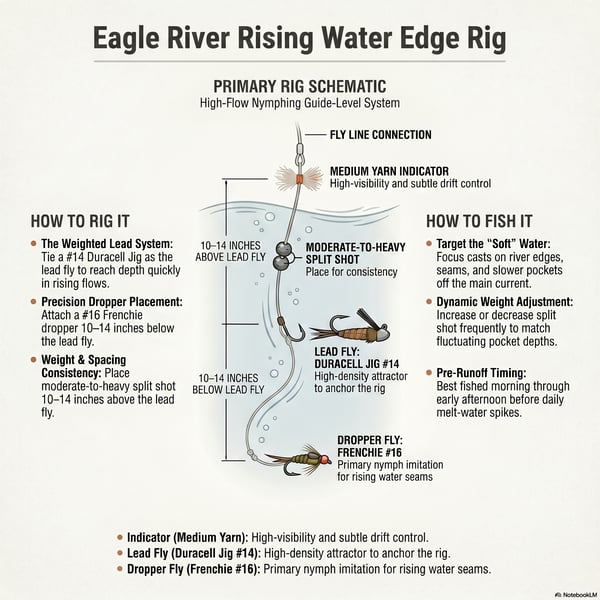
Eagle River Rising Water Edge Rig
- Indicator: Medium yarn or high-vis indicator
- Lead Fly: Duracell Jig #14
- Dropper: Frenchie #16
- Weight: Moderate to heavy (adjust constantly)
- Spacing: 10–14 inches
- Target Water: Edges, seams, and slower pockets off main current
Eagle River Hatch Chart – March
| Bug Type | Size | Notes |
|---|---|---|
| Stoneflies | 12 to 16 | Primary early spring freestone driver |
| Midges | 18 to 22 | Present in slower seams |
| Baetis | 18 to 20 | Limited but possible on mild afternoons |
Access Points
Avon Whitewater Park | 📍 Locals Rating ⭐️⭐️⭐️⭐️ 4.0
Urban access with deep winter holding runs.
Edwards Stretch | 📍 Locals Rating ⭐️⭐️⭐️⭐️ 4.0
Long seams and consistent winter structure.
Eagle Town Reach | 📍 Locals Rating ⭐️⭐️⭐️ 3.5
Defined pockets near town access.
Gypsum State Wildlife Area | 📍 Locals Rating ⭐️⭐️⭐️⭐️⭐️ 5.0
Reliable winter flows and broad seams.
Dotsero Confluence | 📍 Locals Rating ⭐️⭐️⭐️⭐️ 4.0
Mixed flows create productive winter edges.
Stop Here After the River

After fishing the lower Eagle, head to Eagle River Brewing in Gypsum. It has a relaxed local crowd, warm lighting, and the kind of small town energy that fits a winter session on the river. Order the Red Lane Amber and the smoked brisket sandwich. It is simple, hearty, and exactly right after a day spent working slow water and tiny flies.
Local Regulations and Notes
- Respect all posted private property along the Eagle River
- Barbless hooks strongly recommended for winter trout
- Watch for early forming shelf ice in shaded banks
- Step lightly and wade minimally in low clear flows
FAQ
Is the Eagle River Good for Fly Fishing in Winter?
Yes. The Eagle River offers consistent winter trout fishing with lighter pressure than nearby tailwaters. Trout hold predictably in classic freestone winter structure.
How Does the Eagle Compare to Tailwaters in Winter?
The Eagle fishes more naturally. Trout feed less often but are less pressured, making water choice and timing more important than fly changes.
Technical Is the Eagle River Right Now?
Moderately technical. Clean drifts matter, but the Eagle is more forgiving than highly pressured tailwaters like the Blue or South Platte.
Q: Is the Eagle River worth fishing in winter near Gypsum Colorado?
A: Absolutely. With stable flows and reliable midge activity, this is one of Colorado’s most consistent winter freestones.
Q: What rod and tippet setup works best?
A: A 9 foot 4 or 5 weight with 5X to your lead fly and 6X to your midge dropper gives you the control and finesse winter conditions demand.
Q: Can you find dry fly action right now?
A: Occasionally. Calm sunny afternoons may produce short midge clusters in soft edges.
Q: Do streamers work in these low flows?
A: Smaller leeches and neutral-color streamers can move fish on overcast days, but nymphing is the primary program.
Q: When is the bite strongest?
A: Typically 11 a.m. to 3 p.m., when water temps rise slightly and midges get active.
Q: How do I avoid spooking fish?
A: Approach from downstream, keep wading minimal, and make your first drift precise. Low winter water does not forgive rushed movements.
Q: Is the Eagle River good in winter?
A: Yes. It offers consistent winter trout fishing with less pressure than many tailwaters.
Q: How technical is winter fishing here?
A: Moderately technical. Good structure helps, but depth control is still critical.
Q: Are dry flies an option right now?
A: Rarely. Subsurface midge patterns dominate winter success.
Q: Does snow affect fishing much?
A: Short-term snow can reduce clarity, but fishing often improves once flows stabilize.
Q: When does the bite shut down?
A: Typically mid-afternoon once temperatures drop and shadows stretch across the river.
Companion Article for December